

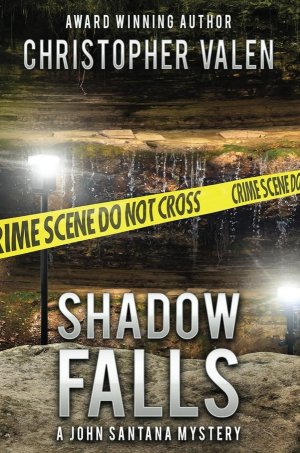

En una noche de calor sofocante a finales de junio, fue hallado el cuerpo de Sabrina Lockwood, la hija rebelde de 19 años de un rico inversionista, el cuerpo se encontró posado a manera de rito sobre una pila de rocas en Shadow Falls Park, la chica fue estrangulada y abandonada en una especie de altar, su asesinato conmociono a la ciudad de St. Paul. Los detectives de homicidio John Santana y Gabriel Cruz tienen la tarea de desenredar la misteriosa muerte de Sabrina, un caso que parece no tener respuestas.
A medida que Santana y Cruz profundizan en la investigación, van emergiendo secretos inquietantes que vinculan a Sabrina con un inframundo peligroso de sectas, chantajes y conspiraciones ligadas a la inteligencia artificial. Una misteriosa fotografía rebela la conexión de Sabrina con un líder Satánico, se encuentra también un video inquietante de Sabrina encontrándose con un extraño en un estacionamiento que parece implicar a sus seres queridos.
Con furiosas protestas frente a la casa del líder de las sectas Ezekiel Shade y una lista de sospechosos los detectives libran una carrera contra el tiempo para resolver el asesinato de Sabrina, pero con cada pista, aparece una red de engaños cada vez mas profunda y oscura donde nadie es inocente. Poco a poco los lazos familiares se desmoronan y van surgiendo agendas ocultas. Santana y Cruz deben desenmarañar un laberinto de mentiras para encontrar la verdad detrás de la muerte de Sabrina.
The John Santana Series: Books 1-3 (2015)
If you’re a police procedural fan and new to the John Santana novels, here’s the perfect way to begin.
The boxed set includes: White Tombs, The Black Minute, and Bad Weeds Never Die.

eBook Only
Amazon
The John Santana Series: 4-6 (2020)
John Santana is back in the second boxed-set of the thrilling mystery series.
The digital boxed set includes: Bone Shadows, Death's Way, and The Darkness Hunter.

eBook Only
Amazon
The John Santana Series: 7-9
John Santana is back in the third boxed-set of the thrilling mystery series.
The digital boxed set includes: Speak for the Dead, The Price of Life, and No Way to Die.

eBook Only
Amazon
In the sultry heat of a late July evening, the body of Sabrina Lockwood, the rebellious 19-year-old daughter of a wealthy venture capitalist, is found ritualistically posed on a pile of rocks in Shadow Falls Park. Strangled and left as if on an altar, her murder sends shockwaves through St. Paul. Homicide Detectives John Santana and Gabriel Cruz are tasked with untangling the mystery of Sabrina's death—a case that seems to lead only to more questions.
As Santana and Cruz dig deeper, unsettling secrets emerge, linking Sabrina to a dangerous underworld of cults, blackmail, and AI conspiracies. A mysterious photo, an affair with ties to a Satanic leader, and a haunting video of Sabrina meeting a stranger in a parking garage—all seem to implicate those closest to her.
With protests raging outside the home of cult leader Ezekiel Shade, and a mounting web of suspects, the detectives race against time to solve Sabrina’s murder. But with each lead, they uncover a deeper, darker web of deceit, where no one is innocent, and no one can be trusted. As family ties crumble and hidden agendas surface, Santana and Cruz must navigate a maze of lies to reveal the chilling truth behind Sabrina Lockwood’s death.
“Christopher Valen creates a story filled with timely current events, controversy, mystery, intriguing characters, and plot twist that will keep you entertained and guessing throughout the book" . . . Hard to put down once you get started . . . one of the best in the series . . . I was expecting an excellent read and I was not disappointed! . . . a gripping detective. novel . . . Valen's writing is rich and paints vivid portraits of of both the city and its inhabitants.”
—Amazon Reviews
CHAPTER 1
The young woman lay on her back on a small makeshift altar of rocks in Shadow Falls Park, her pale, naked form arranged with an unsettling care that bordered on reverence. Behind the altar, a thick layer of moss shrouded the high limestone outcrop that looked out over the Mississippi River and the waterfall hidden beneath.
Yellow crime scene tape attached to the trees fluttered in the light breeze. LED tripod floodlights set up around the perimeter bathed the night scene in harsh white light. The illumination cast sharp shadows over the dry dirt and decaying leaves, creating an eerie atmosphere that, despite the hot and humid July night, sent a cold shiver down Detective John Santana’s spine. He quickly brushed off the feeling, focusing on the task at hand.
Santana and his partner, Detective Gabriel Cruz, had parked in the lot off Summit Avenue and taken the two-tenths-of-a-mile trek along a dark, wooded trail. After passing over the falls, the trail wound down a narrow, uneven footpath and steep
bluff leading to the base of the falls, which now was nothing more than a trickle.
The heavy smell of earth and moss mixed with the faint scent of river water. Mosquitoes, looking for fresh blood, buzzed around their heads.
“Should’ve brought repellant,” Cruz muttered.
“Would’ve been a good idea,” Santana said as he swatted away a swarm of gnats.
They’d been out of their air-conditioned detective ride less than ten minutes, but already Santana’s short-sleeved shirt stuck to his back like a wet rag. Thankfully, he had chosen to leave his sport coat in the Taurus, as had Cruz. But it left his arms exposed to the blood suckers buzzing around them.
A stocky male officer with a name tag that read NOLAN held a clipboard with the Crime Scene Log. A taller and slimmer female officer, whose tag identified her as JETER, stood beside Nolan. Both officers looked young and were likely fresh out of
the academy.
Santana and Cruz each signed the log and wrote down their badge numbers. Then Santana looked at both uniformed officers and said, “You were first on the scene?”
“I took the call from dispatch at nine forty-four,” Nolan said, his voice steady despite the unsettling scene before them. “Took about five minutes to get to the parking lot and another seven to get down here. Determined the victim was deceased. Jeter arrived five minutes later and spoke to the two girls who found the body.”
Nolan gestured toward two teenage girls sitting on a couple of boulders ten yards from them. “Then Jeter and I secured the scene.”
Santana thought the girls couldn’t have been more than sixteen years old, both with shoulder-length hair—one honey blonde, one raven black.
“Blonde is Chloe Cassidy, and the brunette is Julia Whitaker,” Jeter said. “Both live three blocks from here. Said they were out for a walk, but I doubt they’re telling the truth.”
“How come?”
“They’re stoned. I think they came down here to smoke a joint.”
“Any wits?”
Jeter shook her head. “Not yet.”
Santana lifted up the crime scene tape, and he and Cruz stepped underneath it. As they walked toward the makeshift altar, Santana saw Reiko Tanabe, the Ramsey County medical examiner, leaning over the body.
Santana stopped next to Tanabe and focused all his attention on the victim. Cruz walked around to the opposite side of the rocky altar and did the same.
The victim had wavy, sandy-blonde hair that framed her face and a small, delicate figure. Her dark blue eyes, staring into the nothingness, were now obscured by the white cloudy film that typically appeared two hours after death and the scleral hemorrhage and petechiae of the conjunctiva of the eyes.
Her facial muscles had contracted as adenosine triphosphate, or ATP, drained from them, leaving a look of surprise forever etched into her fine features. It was as if she’d been caught off guard by her own demise, Santana thought, leaving her with no time to comprehend the finality of the moment. He knew that her expression would be etched in his mind, joining the faces of the dead that haunted him in his dreams and kept him from sleep. The image of her face in the final moments before death took her would be the driving force behind his mission.
“Find an ID, Reiko?” he asked.
Tanabe adjusted her wire-rimmed glasses as she squatted beside the body. “Preliminary search hasn’t turned up a purse, a wallet, or clothes,” she said. “Appears the vic has been strangled with a soft material, like a towel or scarf.” Tanabe pointed to the faint ligature mark encircling the young woman’s neck.
Santana knew if the ligature was hard material, the furrow would usually be deep and well-demarcated, with an impression of the twist of the ligature on the skin. The fine petechiae, or tiny, unraised spots of bleeding, under the skin of her face and just
above the ligature mark, and the hemorrhaging in her eyes, also indicated death by strangulation.
“Rigor in the face, but nothing in the muscles of the hands and upper limbs,” Tanabe continued, running a gloved hand over the body.
Santana saw no indication of decomposition, which began about eighteen hours after death. Despite her nakedness, she had no mosquito bites, as they used body heat to find their meals and wouldn’t try to drink from a cold, dead body.
Tanabe gently rolled the body on its side, exposing the dark purple discoloration due to the pooled blood settling in blood vessels after circulation had ceased. No postmortem lividity appeared on the shoulder blades, buttocks, calves, and heels that
had come into contact with support surfaces. Blanching had captured the shape and pattern of the rocks that were in contact with the dependent parts of the body surface during livor mortis formation.
The distinctive appearance of contact blanching led Santana to believe that the young woman had not been strangled here, or that her body had been brought here shortly after her death.
He couldn’t help but think about her final moments. What had she been thinking and feeling as her life slipped away? Did she know her killer? And perhaps most importantly, what secrets lay beneath the surface, waiting to be uncovered?
Using a scalpel, Tanabe made a small incision in the upper right abdomen. No blood came from the cut. She then passed a rectal thermometer into the liver to measure the core temperature of the body. Finding this out in situ was paramount, as it could be used to give an approximate idea of how long the young woman had been dead.
“Body temp is ninety-five point two degrees,” Tanabe said. “Ambient temp is eighty-one degrees. Given that a dead body roughly loses about one point five degrees per hour till it reaches ambient temperature, I’d estimate that TOD was between two to
three hours ago.”
“Any idea why she was naked and positioned like this?” Cruz asked, unease creeping into his voice. His short-cropped black hair and lean build were hallmarks of his military training.
Santana shook his head. His instincts told him the answer lay buried within the twisted mind of the killer. “Maybe it’s symbolic,” he said.
This was the second homicide case Santana had worked with his new partner since the thirty-two-year-old Cruz had been promoted from Narcotics and Vice. Santana had been impressed with his younger partner’s attention to detail and willingness to
take direction. Most importantly, Santana trusted that Cruz had his back if the situation ever went south.
As he focused his attention on the body, Santana noted a scratch mark on her left wrist and running along the side of her palm. He guessed it had occurred when something, perhaps a bracelet or watch, had been pulled off. It was a clean, white laceration with no blood in the track, though he thought it was deep enough to have drawn blood if her heart had still been pumping.
“You find a bracelet or watch, Reiko?” he asked, pointing to the mark on the wrist.
“Like I said, John, nothing has turned up. I’ll get DNA scrapings from her fingernails.”
“Wonder what happened to her clothes and shoes?” Cruz said.
Santana peered at the bottom of the victim’s feet. They were smooth with no marks, indicating she’d either worn shoes or was carried down here.
“Let’s get a tracking dog in here,” he said to Cruz. “See if we can locate her clothing, purse, and shoes, and any other potential evidence, before it gets compromised.”
“Roger that.”
Santana glanced at the two girls and then added, “Canvass the neighborhood for witnesses. Split the uniforms into pairs and knock on every door within a two-block radius. I don’t care how late it is. We might not have another chance to find someone who saw something. We’ll run background checks on the neighbors later, see if anyone has a criminal record. And run the license plates of the cars parked in the lot. One might belong to the vic. I’ll talk to the girls who found the body.”
Cruz nodded and carefully headed up the steep bluff.
Santana stood still for a moment, scanning the periphery of Shadow Falls Park and the creek above him that flowed over layers of limestone, shale, and sandstone and into this deep ravine at the west end of Summit Avenue. The unnatural brightness from the LED tripod floods had a way of making even the most innocuous shadows seem sinister.
He felt a pang of empathy for the victim and her family, knowing that their lives would be forever changed by this tragedy.
Tony Novak from the Forensic Services Unit and two crime scene techs had arrived. They would use digital photography and high-resolution 3-D scanning equipment to record and document every aspect of the scene. They wore navy blue jumpsuits with their names embroidered on the left lapel and “FSU” in gold letters on the back. Streams of sweat ran down Novak’s cheeks.
Santana hoped the FSU could find some DNA on the body and on the young woman’s clothes—if they could be located.
Ducking under the crime scene tape, Santana approached the two teenage girls, each still seated on separate boulders. The closer he got, the more he smelled the sweet scent of marijuana wafting from their hair and clothing. They both wore open-toed
sandals, white shorts, and identical green T-shirts with a logo that read:
A DAY WITHOUT WEED IS LIKE . . .
JUST KIDDING
I HAVE NO IDEA
Possession of two ounces or less of marijuana had recently become legal in Minnesota for anyone twenty-one and older, which the two girls obviously were not. But Santana was more interested in what they knew and had seen—if anything—than
busting them for illegal use of pot.
Santana flashed his badge. “I’m Detective Santana. You already spoke to Officer Jeter.”
Both girls nodded their heads but neither spoke.
“I need to ask you a few questions.”
“We already told the other cop what we know,” the brunette said, speaking slowly and enunciating every word, as if to demonstrate she wasn’t stoned.
“You’re Julia, right?”
Her bloodshot eyes widened as if she was surprised Santana knew her name, apparently forgetting that Jeter had gotten both girls’ names.
“Yeah,” Julia said.
Santana looked at the blonde. “And you’re Chloe.”
She nodded her head.
“And you two came down here to smoke a joint.”
“No,” Julia said. “We were just out for a walk.”
Santana stared at her. “Understand this, Julia. You can tell me the truth when I ask you a question, or I’ll have a couple officers give each of you a one-way ride downtown, where you’ll be booked for illegal possession of pot. Your choice.”
Though Santana knew that teenagers couldn’t be charged with a crime for using marijuana under the new Minnesota state law, he was aware of an older statute that allowed for a petty misdemeanor charge when there was no stated penalty. But he
doubted the girls were familiar with this intricacy of the new law—or knew that he was bluffing.
“Okay,” Chloe said, glancing at Julia, as if subtly asking for permission to speak. “We came down here to smoke a joint.”
She spoke slowly and slurred her words.
“And then what?”
“We saw something by the overhang. When we got closer, we realized it was . . . it was her.” She waved an index finger toward the altar.
“Did you recognize her?” Santana asked.
They shook their heads.
“Did either of you touch anything near the body or move anything around?”
“God, no!” Chloe said. “We knew we shouldn’t touch anything, so we just called 911 right away.”
“You’re sure?”
“Yes,” they said in unison.
“Did you see anyone else in the park or anything out of the
ordinary?”
The girls exchanged another glance before shaking their heads. “No,” Chloe said. “We didn’t see anyone. It’s like . . . this is so awful. Who would do something like this?”
“We’re doing everything we can to find out,” Santana said.
Julia Whitaker’s eyes lingered on the body. “Looks like an altar. Like something that the Satanic cult would do.”
“What cult is that?” Santana asked.
“Ezekiel Shade’s. The devil worshipper. I heard my dad talking about him.”
Santana had occasionally seen Shade’s name in the press but hadn’t paid much attention. “What’s your father’s name?”
She hesitated. “I don’t want to get him in trouble.”
“Why would he be in trouble?”
She shrugged. “His name is Damian.”
“Whitaker?”
“Yeah.”
Santana wrote the name in his notebook. Then he said, “I’ll need your phone numbers and addresses.”
“What for?” Julia asked.
“In case I have more questions.”
“We’ve told you everything we know.”
Santana doubted that they had. He looked at Chloe Cassidy. “Yours first.”
She glanced at Julia Whitaker as if for permission.
Julia nodded.
Santana wrote the number down and then shifted his attention to Julia. “And yours?”
She told him.
“Thank you for your cooperation,” he said. “An officer will take you home. If you think of something else that might help, please don’t hesitate to call.”
Santana handed each of them a business card.
“We can walk home,” Julia said.
Santana looked at his watch. It was after eleven p.m. Curfew.
“Take the ride,” he said.
Julia shrugged again.
Santana gestured to Nolan, still holding the clipboard with the Crime Scene Log. “Make sure an officer gives these two a ride home.”
“Understood.”
The moon had long since disappeared behind a thick veil of clouds, casting an unnatural pallor over the park. The pitch darkness made it difficult to discern anything beyond the immediate area bathed in the harsh glare of the LED floods.
It was obvious, based on the small altar, that the body had been deliberately posed. Was it meant to send a message? And who was the vic? She hadn’t been dead long, but without an ID, precious hours would be lost trying to ascertain her identity.
Santana ducked under the crime scene tape and walked toward the altar once more.
Tanabe had placed breathable preservation bags over the young woman’s hands and had secured the bags with the fitted drawstring. The bags, marked LEFT and RIGHT, were much more effective than the old method of using a paper bag secured
with tape.
A clean plastic sheeting had been placed under the young woman, and a body tag with a unique ID number had been securely attached to her ankle. To minimize confusion, another tag with the same number would be attached to the outer bag area.
The plastic wrap ensured that no fibers or trace evidence were lost before she was placed into a black body bag. The wrap also maintained the chain of custody.
St. Paul firefighters from the department’s Advanced Technical Rescue Team had arrived to transport the young woman’s body up the steep bluff and to the autopsy suites at Regions Hospital, where Reiko Tanabe would perform the autopsy.
Santana figured the rescue team would need all their strength to get the body up the bluff, which gave him pause. Again, he wondered if she was alive when she came down here. Not having to carry her body certainly would’ve made it easier for her killer
or killers.
A uniformed officer named Ellison from the SPPD K-9 Unit arrived with his black lab, Buster. They were one of fifteen teams with the department. The dog scented on the young woman’s body and began tracking.
Fifteen minutes later, Santana received a call on his two-way that Buster had located a purse and clothing in a wooded area approximately fifty yards south of the altar.
A driver’s license photo matching the woman’s face identified her as nineteen-year-old Sabrina Lockwood.
Santana recalled meeting the wealthy philanthropist Kenneth Lockwood years ago when he’d worked security for department functions. Lockwood had deep connections within the SPPD, and the revelation that his daughter could be the murder victim added a new layer of complexity and urgency to the case.
Not wanting to further contaminate the scene, Santana thanked Ellison and gave Buster a few pats, which the dog obviously appreciated. Santana would order a more thorough search after sunrise.
He pressed the push-to-talk button on his two-way radio. “Got a preliminary ID on the vic,” he said to Cruz. “Sabrina Lockwood.”
“Where have I heard the name Lockwood before?”
“Media, probably. He’s a well-known philanthropist. But we need to confirm it’s his daughter.”
“Copy that.”
As Santana clipped the two-way onto his belt again, he found himself staring into the darkness as he considered the magnitude of the situation. If the victim now identified as Sabrina Lockwood turned out to be Kenneth Lockwood’s daughter, he and
Cruz would be treading on delicate ground, facing scrutiny not only from the media but also from powerful figures within the department itself.
Lockwood’s influence within the city and police department would surely complicate matters, but he knew that he and Cruz were capable of navigating these murky waters—without interference from the brass.