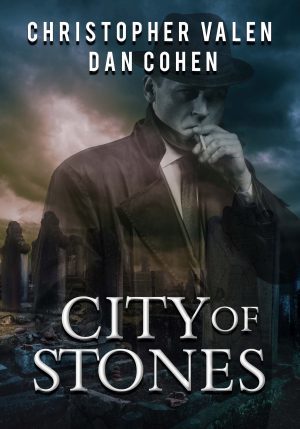
American troops are fighting the Communists in Korea. McCarthyism is on the rise. The Kefauver Commission is investigating organized crime. In the midst of this turbulent time, the murder of a MPD police officer and the two young Jewish men accused of killing him sets off an explosive investigation that ultimately encompasses mobsters, police corruption, political blackmail, and the ethnic biases that existed in 1950 Minneapolis. Known as the most anti-Semitic city in the country, the Minneapolis depicted in City of Stones is a deceitful place, a fact that each character seems intent on using to his or her advantage.
Veteran Homicide Detective Jake Cafferty is battling the bottle and a guilty conscience. Given one last chance at redemption, Jake has a choice to make––one that could cost him everything.
Nick Cole is a war hero looking for a fast-track promotion into Homicide. Determined to impress the woman he loves, he’ll let nothing stand in his way, especially a past that haunts his nights and threatens his career.
Kate Dawson is on a mission to make a name for herself as the first woman attorney hired by the DA’s office. But in trying to take down a crooked cop she’s risking her career––and ultimately her life.
“ . . . City of Stones by authors Christopher Valen and Dan Cohen is an eloquently written, blazing historical mystery, whodunit, with well-timed thrilling action! The blend of all three main characters is perfectly designed. The many peripheral characters in this work of fiction assist the story brilliantly . . . Images are easily visualized . . . You're not just reading a book — but experiencing the story! . . . City of Stones is easily a ‘keeper’ and easily 5 stars.”
—Robert Leon Davis for Reader Views.
PROLOGUE
Minneapolis August 31, 1950
The rain is cold and edged with hail as it blows over the faded hotels, flophouses, and rescue missions in the Gateway District. It hammers the neon lights and glass windows of the brightly lit bars and liquor stores, and gusts over the railroad tracks between the Mississippi and the old, gray buildings of Skid Row.
Huddled in the trunk of a car, his clothes soaking wet, his body bruised from a beating, Martin Crenshaw knows it’s a one-way ride. The two unmasked men who tossed him in here aren’t worried about being identified. The tip of a pointed shovel Crenshaw touches confirms it.
He’ll soon be digging his own grave.
His fingernails claw helplessly at the trunk lid. He made a mistake. Trying to help his family. No reason to die over a mistake. He prays the car keeps going. As long as it does, he’ll stay alive. But twenty minutes later the driver pulls off the road and kills the engine. He hears the two men get out. One opens the trunk.
The bigger man grabs one of Crenshaw’s arms and drags him out. “Walk,” he orders.
Crenshaw shuffles his feet, then makes his legs go limp. Dead weight.
A second man, nearly as big as the first, pulls a shovel out of the trunk and slams the lid. “Ditch him here. We’ll look for a spot off the road.”
The bigger man hauls Crenshaw to the front of the car and leaves him sprawled on the hood, bent at the waist, arms out-stretched, his face kissing warm metal.
The two men tromp through the thick, wet vegetation at one thirty in the morning, unconcerned about noise.
“Here,” the second man says, pointing to a spot on the ground, thirty yards off the road, in a thicket. “Lots of trees. Rain has stopped. Soft ground.”
“Better be,” the bigger one says. “Can’t take all night. And I ain’t diggin’ the hole.”
“Who said you were?”
The bigger man points toward their car. “How the hell is he gonna dig? He can barely walk.”
The second man looks in Crenshaw’s direction and shrugs. He sinks the shovel into the soft ground and begins digging. The bigger man watches.
Ribs hurting, legs like Black Jack taffy, Crenshaw knows he’s a dead man if he stays here. Probably a dead man no matter what he does, but at least he can try. Rolling off the hood, Crenshaw staggers toward the road.
Leaning on the shovel, breathing hard, the second man says, “There’s another shovel in the trunk. Instead of standing there like you’ve got a lump of coal in your ass, why don’t you go get it?”
But the bigger man’s eyes are focused on Martin Crenshaw.
The second man follows his partner’s gaze. “You were supposed to watch him. Go get him.”
“Give me the keys,” the bigger man says. “I’ll get the other shovel. You get Crenshaw.” He grabs the keys from the second man.
“Okay,” the second man says with a shrug. He drops the shovel beside the hole and goes after Crenshaw.
Crenshaw, reeling toward the road, glances back and sees the second man, walking fast, but not covering much ground.
Crenshaw sucks in cool air, feels a stab of pain in his ribs, and coughs out a foggy breath. Jesus, he winces. Must’ve broken a rib. Still, his legs feel sturdier. On the asphalt now, he jogs, heading toward the bridge in the distance, hoping a ride will come along and save his ass.
He can’t run well in his dress shoes and suit coat. He stops, kicks off his shoes, and slips out of his coat. Running in his stocking feet now, he picks up the pace, avoiding the rocky dirt shoulder, staying on the smoother asphalt.
“Hey!” the second man yells. Panting, he stops, hands on his hips, bent over, a stitch in his side, trying to catch his breath.
“Shit,” the bigger man mutters. He tosses the second shovel back into the trunk and the keys into the front seat, and starts to run.
Crenshaw hears the bigger man’s footsteps pounding the pavement. The bigger man can run, and he’s gaining ground. Crenshaw kicks it into another gear, ignoring the sharp pain in his side.
“Get the car!” the bigger man calls, sprinting by the second man. “Keys are in the front seat.”
Crenshaw is running nearly full out. But the bigger man has long legs and a longer stride. If he’s in shape, he’ll run me down. Was a time, when I was running cross-country in high school, the bigger guy wouldn’t catch me.
Struggling to keep his speed, Crenshaw can tell from the sound of the footsteps behind him that the bigger man is closing––and closing fast.
Ahead, the road curves to the right. A steep, grassy hill left of the road leads up to a railroad bridge. Ten years ago, when he was eighteen, hills were his strength. If he can maintain his stride, hold off the larger man till he reaches the hill, he can beat him. But then he hears the car start, the engine roar. No way he can outrun the car. But maybe he won’t have to.
Crenshaw runs all out. Sprinting into the curve, off the road and up the hill, he gives it everything he has. The footsteps behind him suddenly stop. Then tires screech, a car door slams, gears grind. The car burns rubber, picks up speed, and races toward him.
Caught in the headlights, Crenshaw legs it to the top of the hill and onto the deck of the railroad bridge, his lungs burning; pain like shards of glass stabs his ribs.
Tires squeal. The headlights go dark. The second man kills the engine. The two men get out and lumber up the hill.
Crenshaw looks to his left and right. He sees two sets of tracks. No trains coming. He’s alone. Running again, slower now, he makes it halfway across the bridge before the pain in his ribs stops him. He stumbles to the railing, a queasy feeling in his stomach as he looks down at the dark water far below, his only means of escape. The two men are coming, their heavy footsteps thundering on the wood deck between the tracks. Crenshaw steps over the steel railing, gripping it with two shaking hands.
Ten feet away both men stop. “You won’t make it,” the second man says, panting.
Trying to catch his breath, Crenshaw says, “What choice do I have?”
“Jump,” the bigger man says, his breath coming in spurts. “Saves us the trouble.”
The second man gives his partner a look and then faces Crenshaw. “We’ll kill you quick. No pain.”
Heart thudding in his chest, piss running down his leg, Crenshaw stares once more at the dark water far below. “No, thanks,” he says with a shake of his head.
Then he jumps and his scream fades like the whistle of a distant train.